
In chemical processing, uncertainty is expensive.
Whether you’re evaluating a new feedstock, troubleshooting inefficiencies, or scaling a process from concept to production, the gap between theory and real-world performance can introduce risk, delay, and cost overruns. Too often, process design decisions are made with incomplete data, leading to oversized equipment, underperforming systems, or unforeseen operational issues.
This is where targeted chemical process lab testing becomes a critical advantage.
Bridging the Gap Between Concept and Production
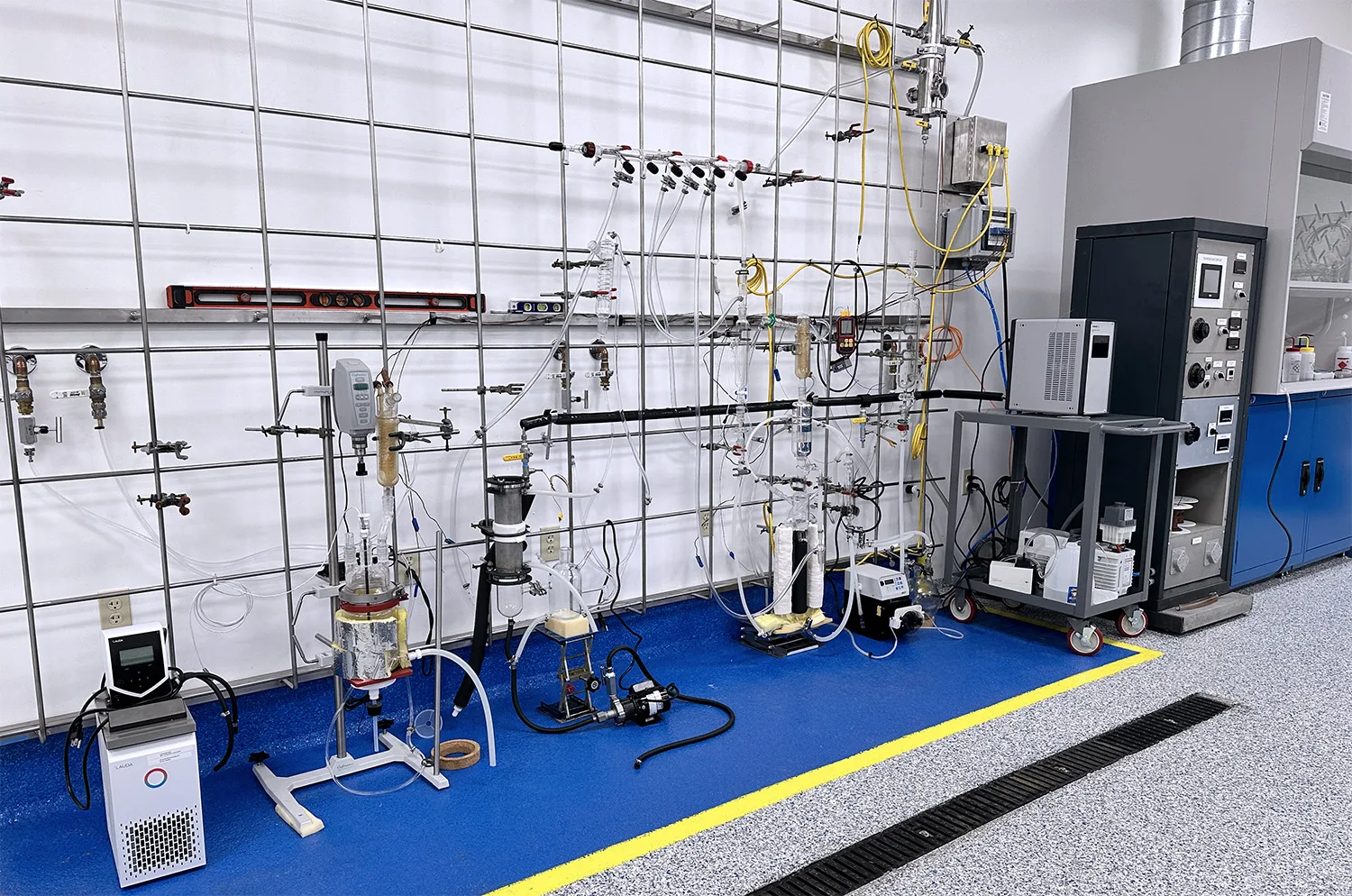
The RCM Thermal Kinetics Innovation Lab & Test Center is designed to validate chemical process design assumptions before capital is committed.
The result is not just data, but confidence.
Lab testing allows you to:
- De-risk process design before full-scale investment
- Optimize operating conditions for efficiency and performance
- Generate accurate material characterization data for modeling and equipment design
- Evaluate multiple processing pathways before selecting a final approach
Chemical Process Lab Capabilities: Distillation, Evaporation, and Crystallization
Our chemical process development lab supports key unit operations commonly used in chemical processing, including distillation, evaporation, and crystallization, under both atmospheric and vacuum conditions.
Distillation Testing for Chemical Process Scale-Up
Our 1.25” diameter lab-scale distillation column with random packing provides a flexible platform for evaluating separation performance and supporting chemical process scale-up.
Key variables we evaluate include:
- Stage count
- Reflux ratio
- Heat input
- Operating pressure (atmospheric down to 0.25 PSIA)
Testing provides insight into separation efficiency and system behavior under varying operating conditions, helping inform full-scale design decisions.
Evaporation Testing and Material Characterization
Evaporation performance in chemical processing systems is highly dependent on how material properties change with concentration. Our lab supports both feasibility testing and more detailed product evaluation.
We can generate data across concentration ranges, including:
- Boiling point elevation
- Viscosity
- Fouling characteristics
- Color and pH changes
Because the system is constructed of glass, engineers can visually assess critical qualitative behaviors such as:
- Fouling tendencies
- Foaming behavior
- Solids formation
- Product discoloration
These observations provide valuable insight that complements analytical data and helps identify potential operational challenges early.
Crystallization Testing for Process Development
Crystallization is a sensitive unit operation where process conditions directly impact product quality.
Our jacketed reactor system supports both cooling and evaporative crystallization testing, allowing us to:
- Evaluate feed materials and the behavior of impurities or contaminants
- Observe crystallization behavior under controlled conditions
- Gather data to support crystallizer selection and chemical process design
Early-stage testing helps reduce risk by identifying how materials behave before committing to a full-scale crystallization system.
Analytical Testing for Chemical Process Design
In addition to unit operations, we provide analytical capabilities to support chemical process optimization and modeling:
- Viscosity
- Water content
- Gas chromatography (GC)
We also generate key datasets such as:
- Boiling point elevation curves
- Solubility curves
These inputs support accurate simulation, equipment sizing, and performance prediction, forming a reliable foundation for chemical process design and scale-up.
From Lab Data to Full-Scale Process Confidence
One of the broader conclusions of the article is that traditional compartmentalized design approaches often eThe goal of any testing program is not just data collection; it’s informed decision-making.
At RCM Thermal Kinetics, lab results are used to guide chemical process design and reduce uncertainty before implementation. By understanding how a system behaves at the lab scale, engineering teams can move forward with greater confidence.
The outcome:
- Reduced technical risk
- More informed design decisions
- Improved likelihood of successful scale-up
When to Use Chemical Process Lab Testing
Chemical process lab testing is especially valuable when:
- Processing new or variable feedstocks
- Scaling up from bench-scale concepts
- Troubleshooting existing system inefficiencies
- Designing systems with specific product requirements
- Evaluating different process approaches
If your process involves uncertainty, lab testing is one of the most effective ways to reduce it.
Ready to de-risk your chemical process design?
Work with the RCM Thermal Kinetics Innovation Lab to generate real data, optimize performance, and confidently scale your project. Talk with our engineers